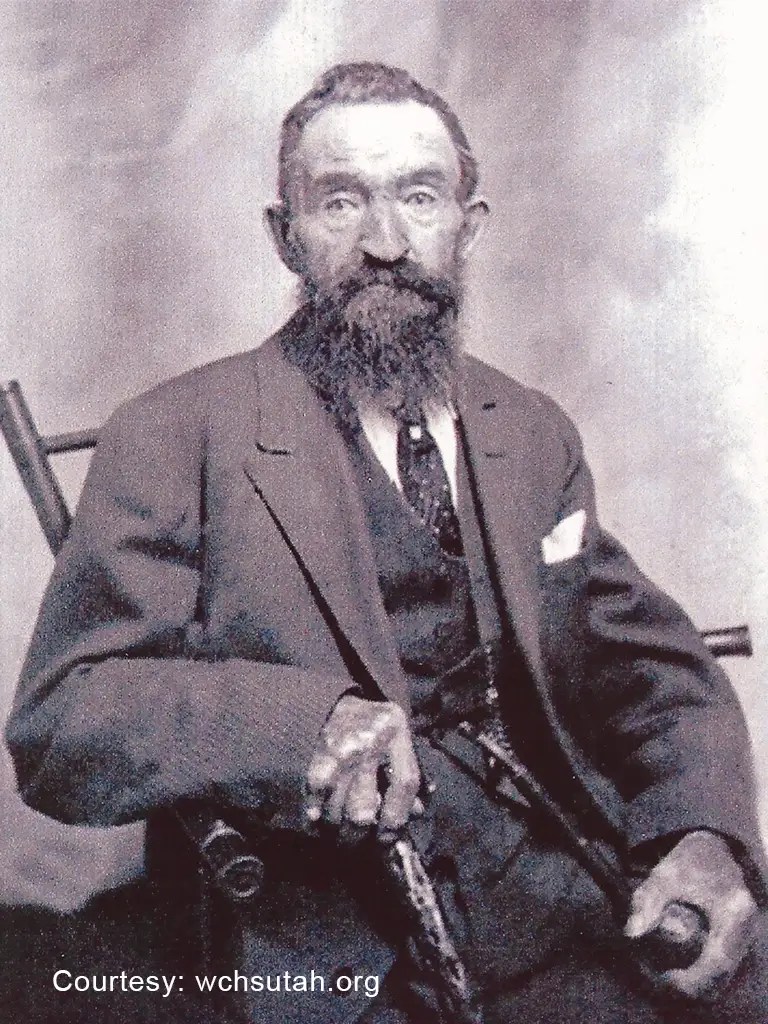
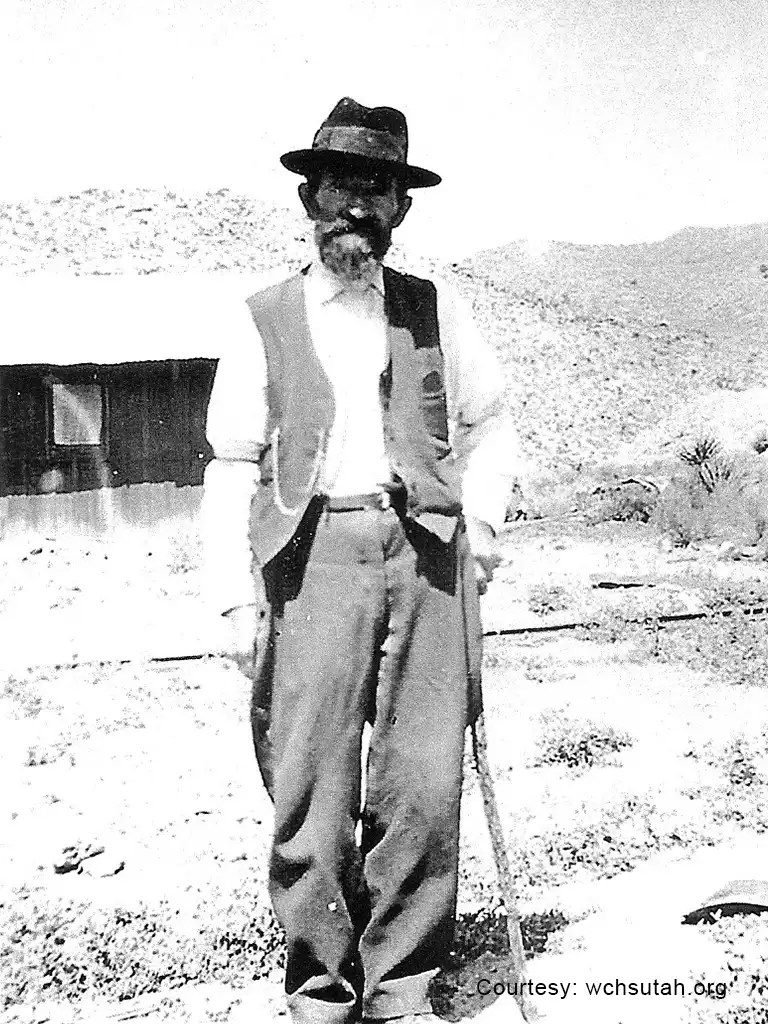
John Kemple
Many stories circulate about who first discovered silver in Silver Reef, but the one figure consistently documented as finding silver ore was John Kemple. In 1866, Kemple rode into the Leeds–Harrisburg area during a prospecting journey from Montana. Though he never struck a major bonanza, he was an exceptionally skilled prospector and assayer, able to read rock the way others read a map.

Not far from where he was staying in Harrisburg, he recognized a specimen known to contain silver — with one complication. The ore was embedded in sandstone, a rock type widely believed at the time to be incapable of hosting precious minerals. That single contradiction set off a chain of events that would ignite the rush to Silver Reef.
John Kemple was born December 11, 1835 in New Jersey. He was the only son and second of six children of George Kemple and Hannah Foster. The family moved to West Virginia and then Marshall, Virginia, by 1840. His mother died when he was ten, and his father remarried and had seven more children. On the 1850 census, he was living with his family in Marshall, Virginia. He had difficulty getting along with his stepmother, so in 1850 he left for California’s gold rush at age fifteen.

A biography of John by his great grandson includes the following: “John followed up every new camp that was started but never found the big one. He joined the rush to Alaska and the Klondike gold fields but was also unsuccessful there. One year in Alaska he was so far north that winter caught his party on the polar ice pack. They would have starved, except that he discovered a mammoth, frozen in the ice. They managed to dig in far enough to cut meat from the pre-historic beast and eat it. He told also of another, smaller figure, deeper in the ice, which he said looked like a human. A few years later he tried to lead a scientific expedition back to the place but couldn’t find it again.”
In 1866, John rode into the Leeds-Harrisburg area with a small string of horses, on a prospecting journey from Montana. He rented a room with the Orson Adams family of Harrisburg for the winter. John had assay equipment with him, and probably assayed materials that seemed to hold possible ores. In the spring of that year, he left for White Pine (near Ely), Nevada. He sent some ore samples from Harrisburg to another assayer, H. H. Smith of Beaver County, Utah. Smith refused to assay it, claiming: “Kemple must be crazy to ask me to assay a sand rock”. John found silver float that assayed over $17,000 per ton. However, he didn’t seem to know its source.
 | See the separate article on Harrisburg |

Reminiscing many years later, John visited David McMullin in his blacksmith shop at Leeds and told the story of his life. He asked, “Dave, you remember that soap-stone vein in the White Reef on the north side of the pass through which Quail creek flows, and is now covered with a swamp? You got soap-stone there and made slate pencils. That is where I got the ore from which I extracted the silver button I showed you nearly forty years ago. The soap-stone assayed 36 ounces in silver”.
Returning to Harrisburg to spend the winter again in 1868, Kemple made more silver discoveries. Most of the ore he found was in the flat area near Quail Creek and east of the White Reef. The ore was simply scattered around. Knowing that the ore probably fell and rolled down from a possible vein at a higher location, he started searching the area nearer the mountains to the west.

Makes First Mining Claim
Finally, in February 1871, after finding the source of the silver ore, Kemple made his first mining claim on a ledge just a half mile northeast from the current entrance station to the Red Cliffs Recreation Area. That same month, Kemple and several others organized the Union Mining District. Between February 1871 and October 1872, a total of 16 claims were recorded in the district. Shortly after, Federal mining laws changed, so they reorganized the district with a new chapter and renamed it the Harrisburg Mining District. This would be the district that Silver Reef was known for being in.
After the district was reorganized, Kemple made a more official mining claim in 1874. Others followed suit and, interestingly, many of the new claims were made in the names of wives from Harrisburg and Leeds. The reason for this was possibly a way men could make claims to potential riches, while not upsetting stern direction from the church’s leader, Brigham Young, who was against members of the church from practicing the extraction of valuable minerals (other than coal or iron) on account of it not being a sustainable way to make a living.
John married in 1874 and became a member of the Mormon Church. He and his wife moved to Silver Reef just as the rush was beginning the following year, where he was employed in the mines. In 1879, he moved his family north to Beaver County.
Still infected with the prospecting bug, Kemple moved his family again in 1891, this time to White Hills, Arizona, halfway between Hoover Dam and Kingman. It wasn’t long before he was broke and asking around for “grubstakes” to fund his next mining venture. Unable to support his family, which by now included five children, his wife divorced him.
Shortly after his divorce, Kemple really did strike it rich from a gold and silver discovery nearby. It became known as Kemple Camp and can be found on a map today. Kemple continued to live in this area and passed away in Kingman on October 14, 1918 and buried in the Kingman Cemetery.