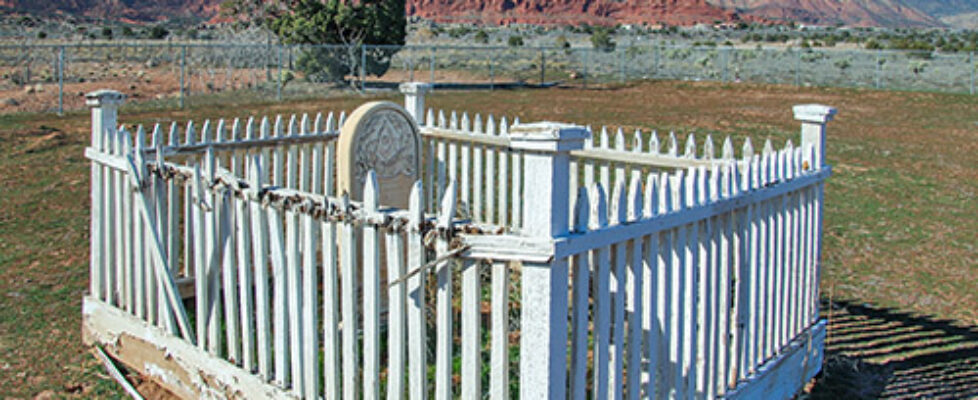
Between Silver Reef, Leeds and Harrisburg, there were a total of five cemeteries, four of which that can still be visited today. Mostly Mormons were buried in the Leeds cemetery located on the southwest side of town. Most people associated with the Silver Reef boom years were buried in either the Catholic or Protestant cemetery. There was also a Chinese cemetery.
About the Cemeteries
During those years, members of the Catholic church outnumbered the others, including members of the more prominent Mormon church, mainly because of the large number of Irish people working in the mines and mills. A fair number of people were splintered between the various Protestant denominations such as Presbyterian. The cemetery in Harrisburg consisted mostly of people from the Mormon Church.
The Chinese established their own cemetery. Archeological evidence suggests its location was adjacent to and on the east side of the Catholic cemetery. After Silver Reef declined, all the bodies were exhumed and sent to China, as it is their belief that their deceased should rest in their homeland.
According to records, the Catholic cemetery has 3 graves with tombstones and 15 graves with “unknown markers, whereas the Protestant cemetery has 11 graves with tombstones and 32 graves with “unknown” markers.
The Catholic and Protestant cemeteries were restored by the Leeds Lion’s Club in 1998. Much of the white picket fences and walls you see today were constructed then.
The dirt road leading to the Protestant cemetery
Protestant Cemetery
Catholic Cemetery
Entrance to Leeds Cemetery
Visiting the Cemeteries
All of the cemeteries are open and can be visited. Below is a map pointing out all four cemeteries.
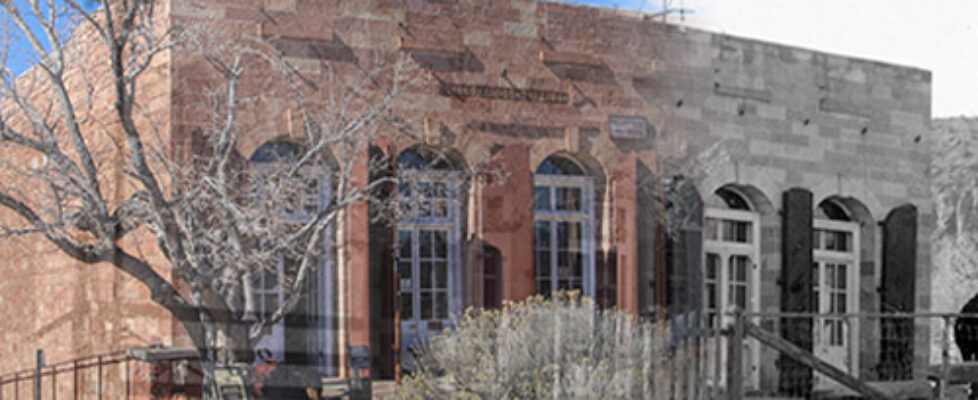
This article is a collection of old and new photographs that can be compared by sliding a vertical bar back and forth. The pictures will give you a good idea of what was once here in Silver Reef during its boom years, and what it looks like today (2026).
Use your mouse to click and hold over the vertical bar, then slide back and forth to reveal different portions of the then and now picture.
Wells Fargo Building (Front)
The Wells Fargo & Express Office building serves as Silver Reef’s museum. The historic picture was taken in 19?? when this building served as a residence?? Oh, and the horse’s name is Clown.
Wells Fargo Building (Rear)
This the backside of the Wells Fargo & Express Office building. The historic picture was taken in 1968. You can see there was a rear deck, which was replaced with full-length rear deck you see today.
In the “now” picture of 2026, the Cassady Powder House, which is where the town’s dioramas reside, was built in the 1980s and was not part of the original building. You might think, is that the same tree? No, it isn’t.
Main Street
These are two different views looking north up Main Street. The contemporary view was taken in 2026, whereas the historic view was taken about 1881.
In the 1881 scene, you can see the Wells Fargo and Harrison House buildings on the left side of Main Street. However, this is before the fire of 18??, which is when the Harrison House burned and was rebuilt of rock. The rock walls remain and are visible just beyond the Cosmopolitan.
View of Silver Reef
These are two different views looking down onto the town along Main Street. The scene is from atop Tecumseh Hill looking to the northwest.
Savage Mine
Before and after view of the Savage Mine on the west side of Tecumseh Hill. The mine sat up on a small rise where wagons would load up ore that was lifted up from the hoisting works and then transported to one of the nearby mills of Silver Reef. The Salvage Mine used a steam engine to lift buckets of ore through a vertical shaft from the various mining levels some 200-300 feet below.
The history of Silver Reef is both similar to other mining boomtowns of the American West and unique with its surrounding culture and the geologically unusual place where the silver was found. When miners arrived around 1875, the area was already home to members of the Church of Jesus Christ of Latter-day Saints, more commonly known as Mormons. Unlike other mines where precious metals were found in quartz or other common rock, the silver here was found in sandstone, causing confusion for seasoned miners and leading to different mining practices.
This article provides an overview of the history of Silver Reef – from when settlers first arrived in the area around 1858 until the 1950s when uranium was mined, to present day restoration and preservation efforts. The article is no replacement for books containing more detailed history, such as Silver, Sinners and Saints, which is showcased at the end of this article. By no means is this article a replacement for a visit and tour of the real thing – Silver Reef.
A detailed historic timeline is in a separate Historic Timeline of Silver Reef article. Below is brief timeline of Silver Reef’s history.
Dec 1861
St. George Founded
St. George, Utah, is founded as a result of the “cotton mission”
Nov 1866
Silver is Discovered
John Kemple discovers silver near Harrisburg
Mar 1875
Mining Begins in Silver Reef
Prospectors and miners begin establishing mining claims
1876 – 1882
Silver Reef's Boom Years
There are good times in Silver Reef for seven years, longer than the average mining boomtown.
1888
Most Mines & Mills By Now Have Closed
The largest mill in Silver Reef stops operating the previous year and another significant mill closes in 1888.
1903
Silver Reef's Buildings Disappear
Many of Silver Reef’s abandoned buildings are dismantled and moved elsewhere.
1986
Wells Fargo Building Restored
Restoration of the Wells Fargo Express building is complete and the Silver Reef museum opens.
2013
Silver Reef Non-profit, Inc.
The Silver Reef Foundation is formed. This Utah non-profit manages the museum today.
The Beginnings
The area around Silver Reef or what is now Washington and Iron Counties, was first explored by an expedition of Mormons from Salt Lake City led by Parley P. Pratt in 1850. Brigham Young, leader of that church, directed Pratt to explore these areas.
In the next two decades, Young would direct several “missions”, sending people to settle this area and begin taking advantage of its resources. This would include the Iron Mission of 1851 that began mining big deposits of iron west of Cedar City and the Cotton Mission of 1861 that would use the warmer climate of the St. George area.
First Settlements
The first settlement near Silver Reef occurred in 1858 when several Mormon families began farming lands north of the Virgin River. The town was named Toquerville after Chief Toquer who led a band of Pauite Indians living along Ash Creek and its confluence with the Virgin River.
Within the next four years, other nearby settlements were founded, including Washington City, Grafton, and St. George. Harrisburg, just south of Silver Reef, was settled in 1859 by a group of families, then was abandoned when most of the same families regrouped and settled again in 1862 after picking a more suitable area, then later moved to Leeds for better farming land. The settling of Harrisburg would become a key factor in the discovery of silver and the creation of Silver Reef.
Mormon Culture
Most of the residents of Washington County followed the guidelines established by the church. Decades earlier, Their leader, Brigham Young advised church members to avoid engaging in mining precious metals like silver and gold. He understood that communities that developed from mining profits often weren’t sustainable, frequently shifting from boom to bust. This wasn’t the kind of successful colonization of the West that Young envisioned.
So, with the exception of mining coal and iron, Young was not very supportive of his members prospecting for, and mining precious metals. He also wasn’t in favor of his members leaving for California or Nevada to try their luck in the gold and silver rushes happening there. Because of this, there wasn’t much prospecting done in Utah.
After moving to the Washington County area in the early 1860s, many of the Mormons settlers faced some tough challenges. Their crops often failed, the summers were very hot, and the water supply from the Virgin River was unreliable. Even when the crops did grow, there wasn’t a large market nearby to sell them. By 1870, things improved a bit when people realized there was a market in Pioche, Nevada, a growing silver town nearby. Still, many settlers decided to give up and returned to northern Utah.
But, by early 1876, as Silver Reef began to boom, the early settlers started to see some hope. As more miners and others showed up during the mining boom, there was a big demand for food and other goods, and the Mormons of Washington County were ready to supply all these new people. Suddenly there was an infusion of cash into their struggling economy.
As Silver Reef started to grow, the relationship between the newcomers (sometimes called “Gentiles”) and the local Mormons sometimes called “Saints “) was sometimes a little strained. Both groups were unfamiliar with each other’s cultures. While both groups worked together, the Gentiles often didn’t understand the Mormons’ lack of sympathy for miners or their lack of interest of mining valuable ore in general.
Looking back from a modern perspective, it seems clear that without the boom years of Silver Reef, the economic future of the Washington County settlements would have been in question. If those boom years hadn’t existed, Southern Utah’s growth would certainly have been stunted.
Silver is Discovered
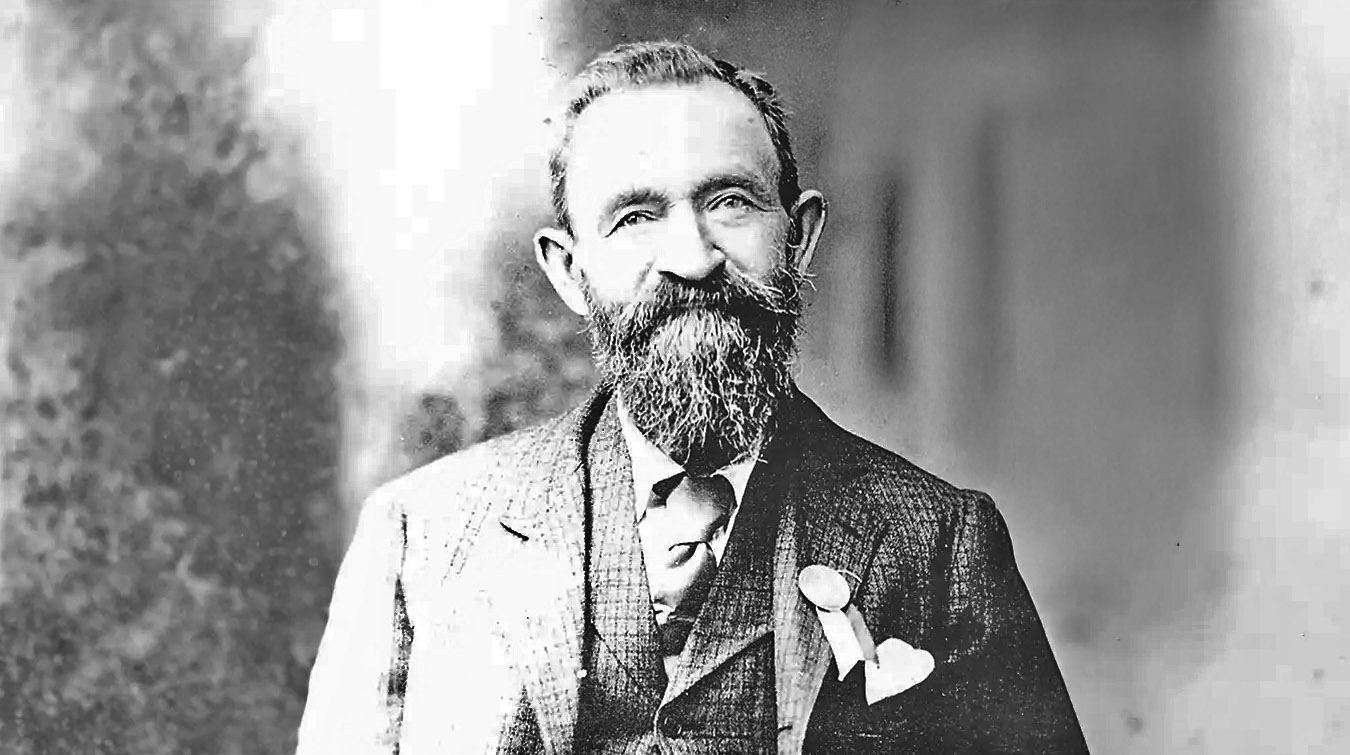
John Kemple rode into Harrisburg in 1866, searching for a place to spend the winter after prospecting for valuable metals in Montana. While waiting out the cold months, he used his prospecting skills to explore the unique landscapes of what is now the Red Cliffs Conservation Area southwest of Silver Reef.
See article What is a Reef?that explains this important geologic feature
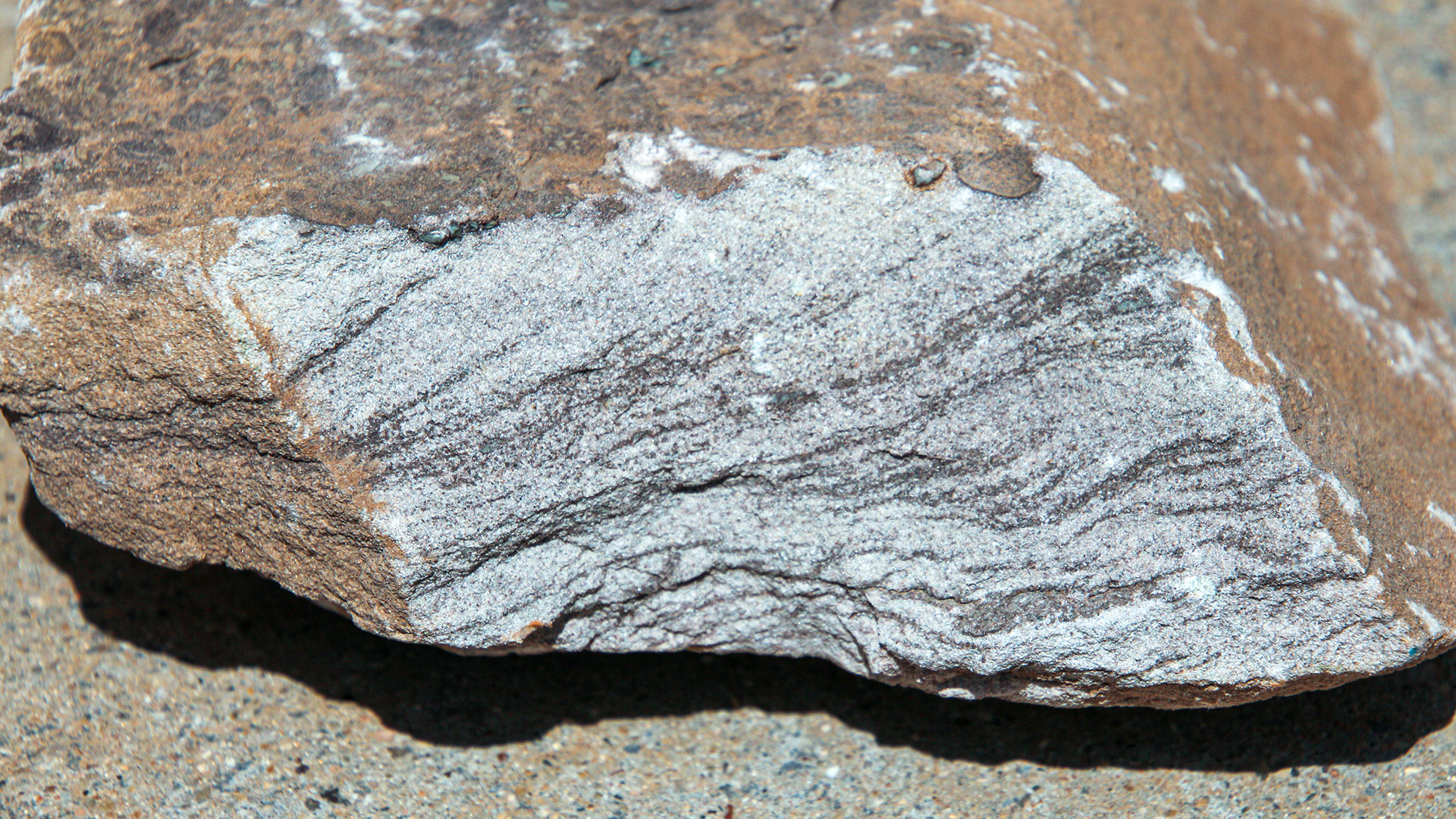
Shortly after arriving, Kemple found what he knew was silver and sent rock samples off to get assayed. It came back at over $17,000 per ton. That sounds like a lot, but it was a big job to round up a ton of that type of rock. Regardless, the rock showed a lot of promise.
A year later, he found the source of the ore – a sandstone layer pushed up by what’s now called the White Reef. Silver ore in sandstone was so unusual that it took quite a while to find believers. It was not until 1872 that Kemple and others organized the Harrisburg Mining District. He filed his first mining claim a little later. By now, word was getting out that there could be a silver bonanza in the hills above Harrisburg, Leeds and Toquerville.
John Kemple
The rock, known as “horn silver”, that Kemple found silver in
Miners Arrive
Now that the word was out, people from all over began arriving in the area to prospect for silver. Articles from newspapers and journals from across the Southwest published stories about the silver discovery, which caught National attention. More claims were filed. Investors from big cities sent agents to the area to see if it was really true that silver could be found in sandstone. Suddenly, Washington County began experiencing a big influx of people.
In 1875, one of those agents who arrived was William Tecumseh Barbee. He was sent by the wealthy Walker Brothers of Salt Lake City to investigate the Harrisburg Mining District. Barbee would become one of the more influential people that sparked the rush to Silver Reef.
Also in 1875, investors from San Francisco organized the Leeds Mining Company. Its mine was located on the White Reef less than a mile from where the Silver Reef museum stands today. It began operation in late 1876 and continued producing silver until numerous equipment failures caused it to shut down in 1882.
By 1878, two more large mills were built: the Christy, the Barbee & Walker and the Stormont, with the Christy funded by more investors from the San Francisco Bay Area. All this would bring more people to the Silver Reef area, greatly increasing the economy of Washington County, much to the delight of the original Mormon settlers. There was now a much larger marketplace for their goods and services. Before long, the two cultures, the Mormons and the miners, formed a symbiotic relationship where each helped each other.
Silver Reef is Founded
As in any new mining camp, as prospectors and miners arrived, they would set up camps, often called tent cities. Tents, dugouts or ramshackle huts to live in. These popped up from Harrisburg to Leeds along the creeks (for water) and the various reefs.
In early 1876, being the entrepreneurial opportunist that he was, William Tecumseh Barbee staked out a real estate development and called it Bonanza City. He had a few buildings erected, including an assay office, a boarding house, general store, blacksmith shop, and a few dwellings. He called it the new metropolis of Southern Utah.
But many miners couldn’t afford Barbee’s expensive lots, so they camped northwest of Bonanza City, closer to the reefs. While Bonanza City was on flat ground, their camp was on land littered with big rocks. So, they named their camp Rock-pile. Soon afterwards, a merchant who moved his business from Pioche to Rock-pile started calling it Silver Reef, and the name stuck.
Both the names Silver Reef and Bonanza City show up on a tract map created in November 1876 by Washington County surveyor John Macfarlane. Later on, Macfarlane, who was a devoted Mormon, played a part in a unique moment in Silver Reef’s history by helping a priest organize a Catholic High Mass at the St. George Mormon Tabernacle.
Beginning in 1876, the prosperous silver mining town of Pioche, about 120 miles or 2-3 days of travel to the west in Nevada, was beginning to have problems. Although Pioche continued to be a successful mining town into the mid-1900s, for various reasons during this time, miners and businesspeople lost confidence in the Pioche mines and began looking elsewhere for the next boom.
Many of those people thought that next boom would be Silver Reef. There was news that the Leeds Mining Company of San Francisco was buying up land and establishing mines. They intended to have a stamp mill running in a few months. When the people of Pioche learned about this, they began leaving Pioche en masse. The aforementioned merchant that named Silver Reef became the agent for the San Francisco investors and began selling lots in Silver Reef at a more reasonable price than Barbee’s Bonanza City.
By October 1876, the famous Pioche Stampede was on. Along the mountainous roads between Pioche and Leeds, a steady flow of people headed east to Silver Reef. They came in carriages, buckboards, heavy wagons, and some on foot with push carts. The goal of the Stampede wasn’t for obtaining mining claims, it was to buy up prime business locations on Silver Reef’s Main Street. When it was over, approximately one-third of the population of Pioche had moved to Silver Reef.
High Times at Silver Reef
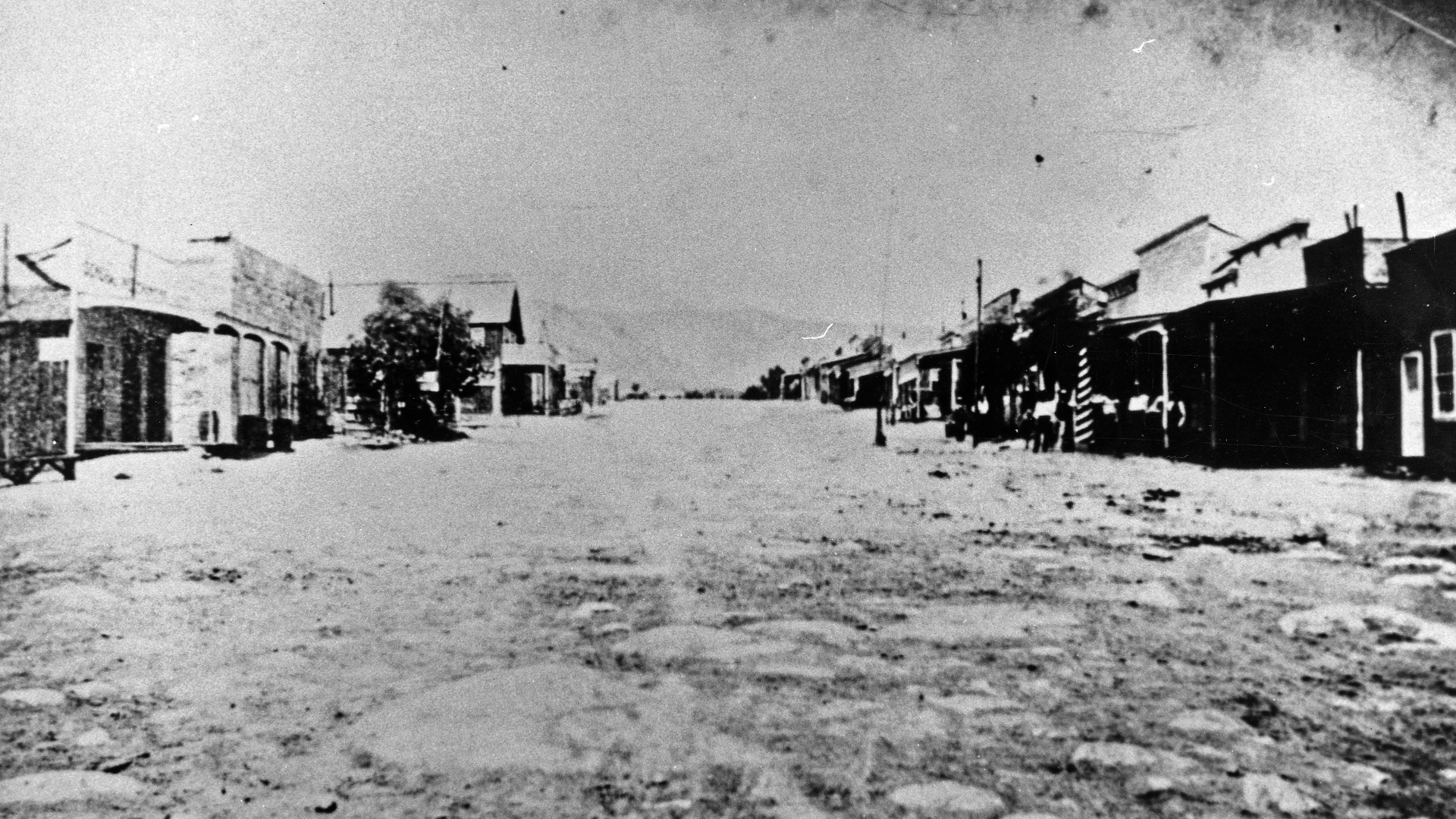
The boom years of Silver Reef were from 1876 until about 1883. By the end of 1882, Silver Reef’s Main Street was supposedly a mile long. Businesses included hotels, restaurants, markets/stores, drugstores, a lumber yard, and several saloons, including the Elk Horn across the street from the site of today’s museum.
Main Street of Silver Reef in the early 1880s
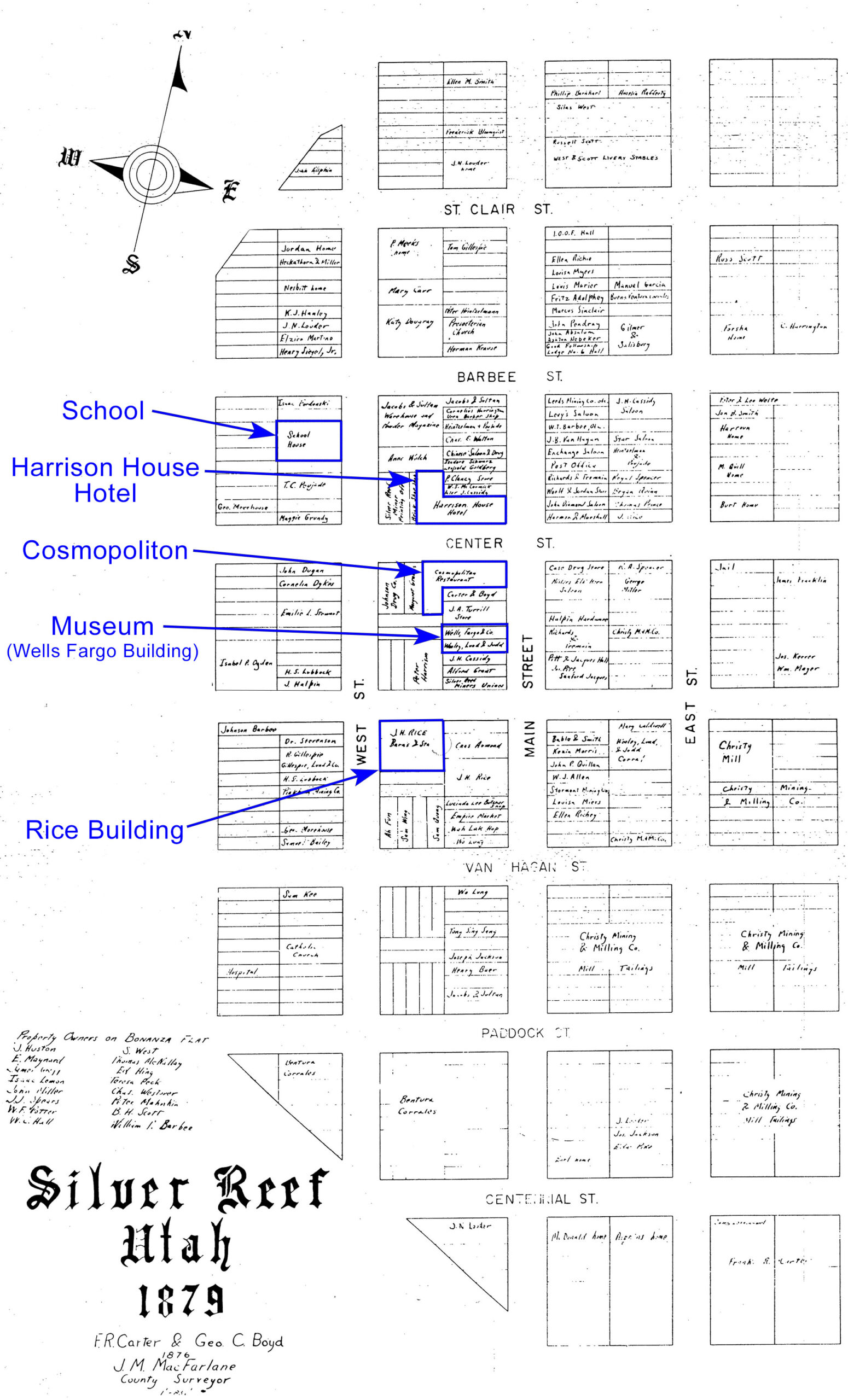
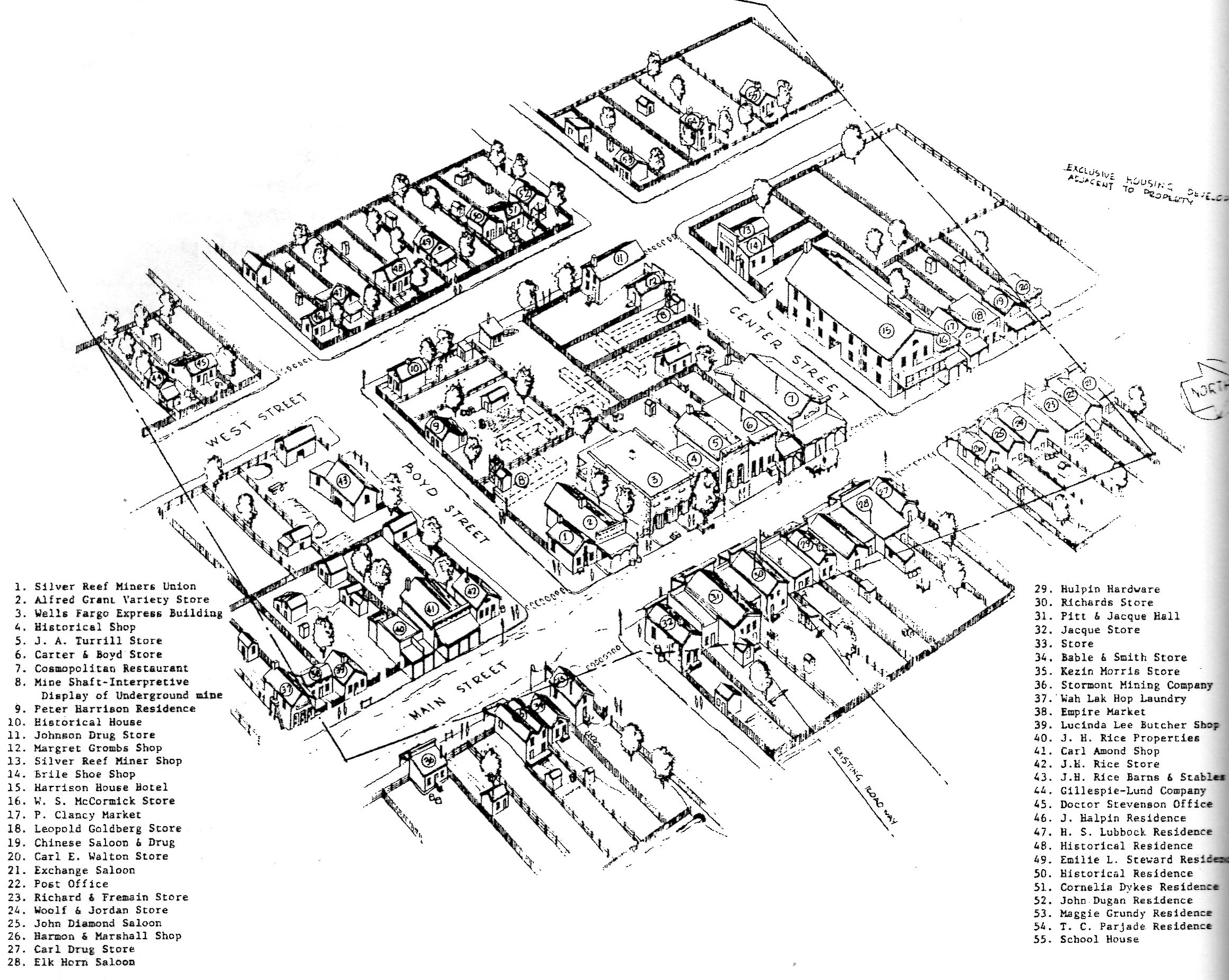
The picture above shows Silver Reef from about 1879. The tract map of Silver Reef below, this one listing and pointing out all the businesses, was drawn, again by John Macfarlane, in 1879.
Tract map of downtown Silver Reef – captions point out common buildings
View Larger Map
See a larger copy of this map in a new tab. Then click image to zoom in.
The first newspaper in town, the Silver Reef Echo published its first edition on February 24, 1877. This was its only issue. James N. Louder, a former correspondent for the Salt Lake Tribune, along with others, purchased the Echo and renamed it The Silver Reef Miner in August 1878. Louder would continue to be involved in Silver Reef, including being the Postmaster and purchasing a building across the street from today’s museum. He hung on until Silver Reef’s bust.
The Silver Reef Miner competed with a newspaper in St. George, The Union. It rarely reported on what was happening in Silver Reef. This gave The Silver Reef Miner opportunity to concentrate on the stories in Silver Reef, mainly mining. Although Silver Reef was the biggest economic boom to Washington County at the time, as discussed earlier about Brigham Young’s wishes to not promote mining, its residents followed suit by not generally being interested.
Thanks to the archives of The Silver Reef Miner, a lot of Silver Reef’s history has been preserved and is now available in several books at the museum’s book store.
How You Can Learn More
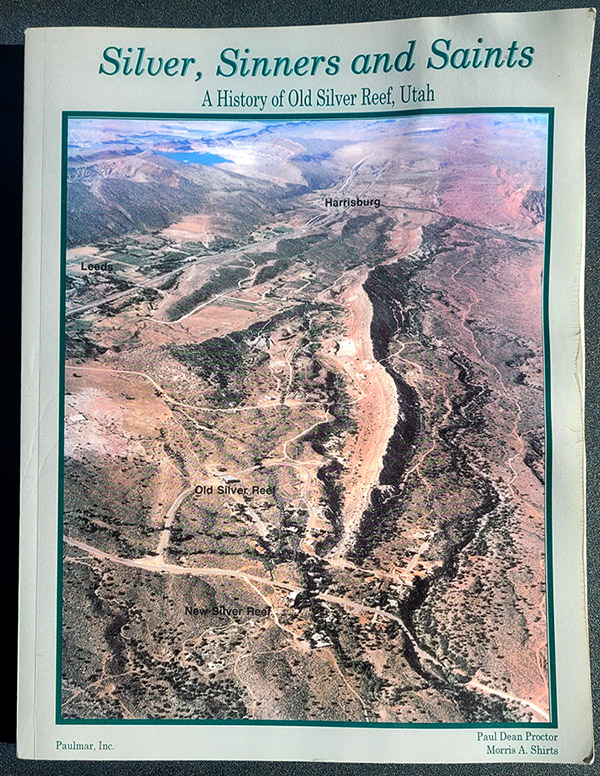
Many of the historical accounts of events which occurred in Silver Reef were obtained from the book Silver, Sinners and Saints, A History of Old Silver Reef, Utah. To learn more about the history behind Silver Reef, purchase your own copy of this book at the Silver Reef Museum gift shop.
Establishments
A school in Silver Reef was planned in 1879 that would be part of the Leeds school district. At that time, it was determined that 75 children of school age resided in Silver Reef. Funded by public donations, a school house was completed in January 1881. After Silver Reef’s demise, the school building was cut in half and moved to Leeds and reassembled, where it remained a school until 1956. In the 1970s, this old building became the current Leeds town hall and still is as of 2026. The site of the school and its surrounding stone walls can be visited along the Silver Reef Walking Tour.
Along with a separate cemetery in Leeds primarily used by the Mormons, three cemeteries were established in Silver Reef. The Catholic and Protestant cemeteries still exist and can be visited today. Both are located about half a mile south of the museum. There is also a small cemetery in Harrisburg that can still be visited in the middle of the Harrisburg Estate neighborhood.
The third cemetery was created by the Chinese residents, but it no longer exists. After Silver Reef declined, some of the bodies were exhumed and sent to China, so that their homeland would be their final resting spot.
Just like in many mining towns of the American West, when news of the silver rush spread, people of Chinese descent started coming to Silver Reef around 1878. As was common in many Western mining towns, the Chinese community faced challenges in being accepted.
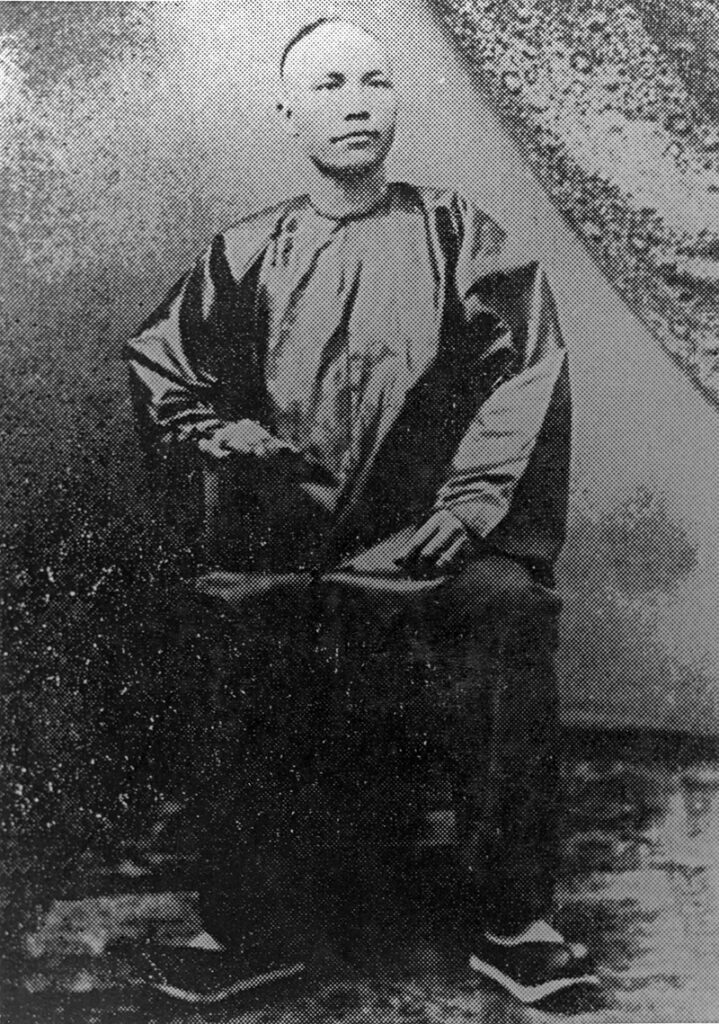
Chinatown was situated just south of downtown Silver Reef, close to the Christy Mill. The community chose their own unofficial mayor, Sam Wing. They established various businesses including retail stores, drugstores, meat shops, laundries, and a chair factory. There was also an opium den. Out of all the residents in Silver Reef, around 100 were Chinese.
Sam Wing – unofficial mayor of Silver Reef’s Chinatown
Like in other mining towns, a Chinese lottery was set up here as well. According to the local Silver Reef newspaper, it was running “full blast…month in and month out”. The stores in town that sold tickets for the Chinese lottery essentially acted as agents for the major lotteries based in San Francisco. The lottery had a fairly complex system behind it. Gambling was quite popular among the Chinese community.
Labor Strike
The labor disputes and resulting miner strikes, beginning in 1881 are regarded as the beginning of the end of Silver Reef’s prosperity. It started on February 1 when miners of the Buckeye Mine of the Stormont Company arrived at work, they were notified that their pay would be cut to $3.50 per day rather than the normal $4. Most miners refused to go to work.
After the morning’s announcement, the workers marched over to the Barbee & Walker Mine and were joined by Union workers there. They all proceeded back to the Buckeye Mine, where they stopped all operations and took possession of the mine. Supposedly, this was the start of the first organized labor strike in Utah. It resulted in 200 men remaining idle for three months.
The mining companies wouldn’t cave into the strikers, insisted that they couldn’t be profitable by paying wages of $4 per day. Only the Christy Company decided to pay their workers the $4 wage and ended up being the only mines and mill in operation during this time, which turned out helping them economically in the long run.
Soon, there were 300 striking miners. Since many of the miners didn’t have much money, they didn’t have any choice but to look for work elsewhere and moved to other distant mining towns. Many went to Tombstone, Arizona. This loss of miners greatly affected businesses in Silver Reef, with some closing up and moving out of town. It also negatively affected the local Mormons economically.
Finally, after many discussions and meetings, the Union voted in April to accept the $3.50 per day wage. Many Irish miners had already left and were replaced by Cornish miners. Some Mormons also started working in the mines. It took about five more months for the mines and related businesses to get back to normal. New miners moved in and businesses resumed, but the Silver Reef boom days were over.
Silver Prices Decline
In 1877, the average price of silver was $1.20 per ounce. By 1883, the price had dropped to $1.11. Naturally, this cut into mining company profits and the ability to stay in business. Often, the difference between booms and busts in mining was driven by the commodities market, as it still is today.
Furthermore, as the easy high-grade silver was extracted from most mines, miners had to dig deeper to extract ore that contained less silver. Naturally, this drove up the costs of operating both the mines and the mills. The deeper the mines went, the more underground water was encountered that had to be pumped out, further making mining more difficult and costly.
By 1885, the price of silver continued to slip and was at $1.06. Slowly, the mines began to close. Over the next 20-30 years the price of silver would rise, tempting a few optimists to try their luck with digging ore out of Silver Reef mines again. Not many succeeded.
As Silver Reef’s prosperity slowed down, many other businesses in Washington County experienced a similar decline. For about ten years, the Mormon pioneers did well by selling their goods to the people of Silver Reef. Once the boom years ended, they had to find new markets to offer their goods and services.
In the end, covering the years of 1877 until 1900, Silver Reef extracted approximately $8.6 million (in 1880s dollars – $261 million in 2026 dollars ) in silver. The graph below plots the dollar value of silver taken out from Silver Reef mines between those years. The vertical axis plots dollars in $100,000 increments (1 thru 12, meaning $100,000 thru $1.2 million), and the horizontal axis plots each individual year.
Demographics
It’s important to realize that during these boom years, mainly 1877 through 1881, an average amount of 1,500 people resided in and nearby Silver Reef. The number doesn’t sound high, but other towns in Washington County only had populations in the hundreds. In fact, Silver Reef was the largest town in Washington County during some of those years. The population varied, where at some times the population could have exceeded 2,000, where at other times it may have been around 1,000. There were no exact or timely census records at the time. However, the museum does have records of people living in Silver Reef during these years.
In comparison, during the same period, Leeds had around 300 residents, Toquerville had less than 200, Harrisburg less than 80, and St. George had around 1,300. Silver Reef was the largest town in Washington County during these years.
The 1880 US Census provides the best population record for this time. Based on it, the Silver Reef Museum has compiled biographies of many residents of the town.
We have no exact record of how many businesses and other establishments were in Silver Reef during each of the boom years, but here is an approximate breakdown by type:
Silver Mines, 30 (approx.)
Silver Mills, 6 – 5 by 1877 – 4 by 1884
General Stores or Mercantiles, 5 – 10
Hardware Store, 2
Drugstore, 3
Butcher Shop, 2
Hotels or Boarding Houses, 3
Restaurants, 2
Saloons, 11
Stables, 1
Barber, 2
Boots & Shoes, 2
Dressmaker, 1
Tailor, 2
Watchmaker, 1
Churches, 1 – Catholic
School, 1
Post Office, 1
Newspapers, 1
The following is an architectural sketch of a possible restoration model of downtown Silver Reef, provided by the 5-M Company (explained in Revival Attempts below). It shows a close approximation and number of businesses in Silver Reef during its boom years. A single year of when this building layout existed is not known.
Rendering of building locations in Silver Reef – zoom in by opening image in new tab
View Larger Map
See a larger copy of this map in a new tab. Then click image to zoom in.
By 1903, many of Silver Reef’s residents had moved away, leaving many buildings and properties abandoned. As other areas in Washington County continued to grow, the buildings at Silver Reef became sources for cheap building materials. Buildings made of lumber were either moved intact or dismantled.
Over a couple of years, many of the buildings in Silver Reef were dismantled and moved to where they could be used or turned into building materials. For example, as mentioned under High Times above, the school building was moved to nearby Leeds. After the Barbee & Walker Mill closed in 1908, even more buildings were available to plunder. Whatever wasn’t salvaged later withered away in the desert sun and the winds swept away the loose material. In the 1930s, the administrative buildings of the Leeds Civilian Conservation Camp (which can still be visited today) were constructed from blocks of sandstone “mined” from Silver Reef buildings.
Once while a lumber building was being taken down, someone discovered a stash of several thousand dollars in gold and silver hidden beneath the floors of one building. This discovery led to more people searching through the remaining buildings, hoping to find similar hidden treasures, which resulted in destroying more buildings.
Silver Reef after many buildings were removed
Revival Attempts & Preservation
In 1916, all mining claims in Silver Reef were consolidated into one property and became the Silver Reef Consolidated Mining Company. But no new mining started. During this time, the owners used the Wells Fargo building as their private residence.
The “tailings” next to the mills, consisting of very fine leftover dirt, still contained unprocessed silver. The same was true with waste piles of rock left near the mines. The technologies used to extract silver from rock ore was not as efficient in 1880 as it was in 1920. All over the West, many miners began “reworking” mine and mill tailings as technologies to extract silver improved, coinciding with when the prices of silver and gold were high.
Furthermore, many people knew that there was still a lot of silver left to be mined below the reefs. One company, the American Smelting and Refining Company, realized this fact and, in the late 1920s, acquired the Silver Reef Consolidated Mining Company properties.
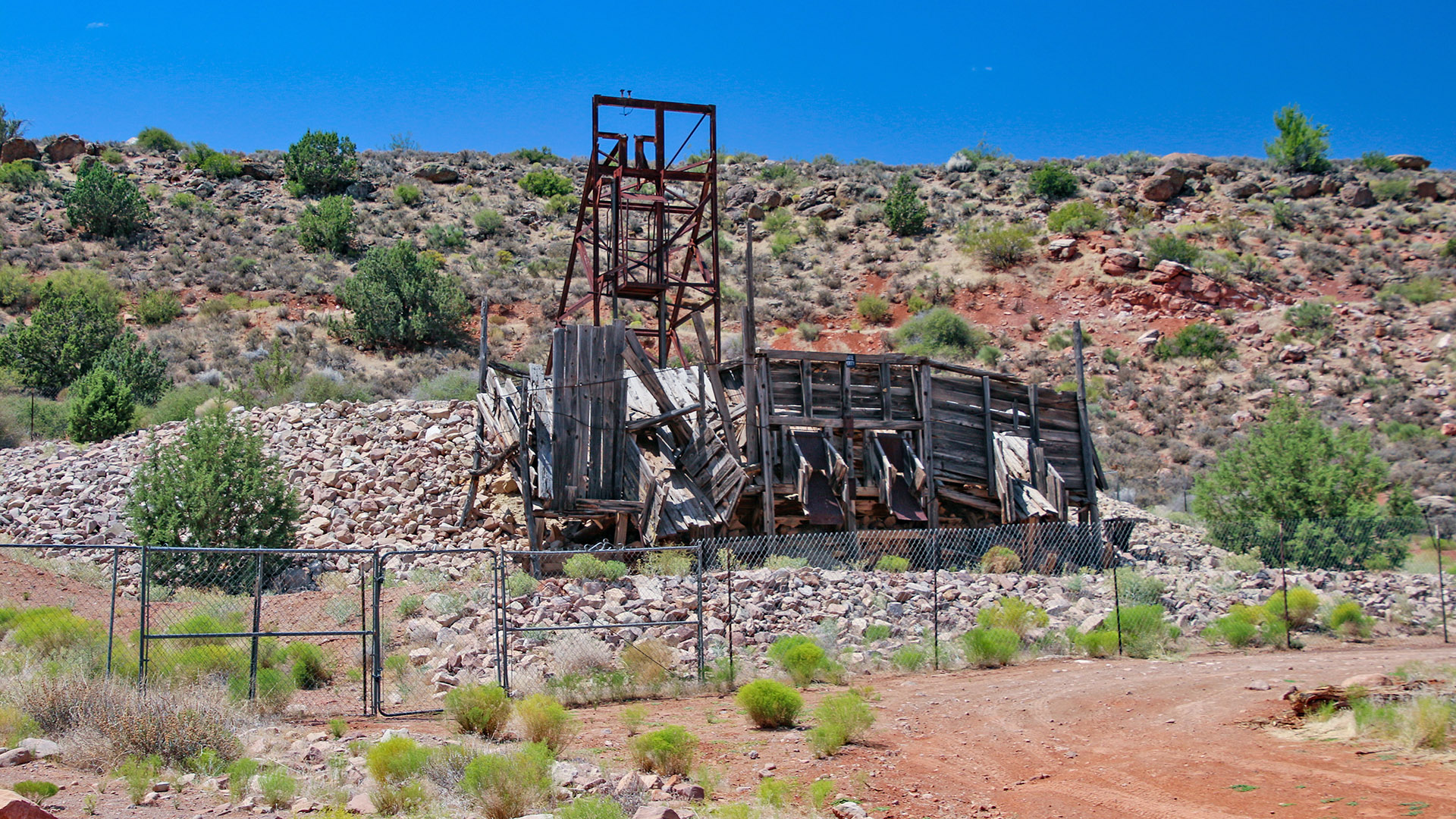
A deep vertical shaft on top of the White Reef was sunk and then a few (horizontal) drifts were dug in hopes of accessing ore deep beneath the two reefs. A large metal headframe was built ready to begin extracting ore. Unfortunately, in 1929, the stock market crashed and the price of silver sank to its lowest level in decades. As a result, the company ceased operation. No large attempt to mine silver was made after that.
See the Silver Mining article to learn more about mining terminology
Today, it’s very large vertical shaft can still be visited using the old road that goes from Silver Reef to the Leeds Mine crossing the White Reef. Although the headframe fell down in 1948, the foundation of the hoisting works remain.
Uranium Mining
In 1948, a new company on the scene, Western Gold & Uranium, Inc., acquired the consolidated properties. They begin reworking the tailings and waste piles. Although they were profitable in doing so, the company had more profitable operations elsewhere and concentrated on them.
When the uranium boom of the 1950s began, Western Gold & Uranium began assaying ore from all of its mines around Silver Reef for uranium. A mine was built on Paulmar Hill, which is part of Leeds Reef, called the Anne’s Pride Mine. This is the mine and headframe seen on the left side of the main road when heading up to Silver Reef today. Several thousand tons of silver and uranium ore were brought up from these underground workings.
Anne’s Pride Mine
In 1956, Western Gold & Uranium built a flotation mill just across the draw from the Barbee & Walker site. The mill is still standing and can be seen on the walking tour. It produced silver-copper concentrates, along with uranium-vanadium-copper concentrates. These concentrates were then sent to other mills to extract the pure metals, like silver and the highly sought-after uranium.
Unfortunately, the demand for uranium soon fell dramatically. By the end of 1959, Western Gold & Uranium ceased both their mining and milling operations.
The next ray of hope of reviving Silver Reef was the 5-M Company. They still own several of the old mining properties to this day in 2026. The owner, Frank Hartley, was related to a miner that worked the Silver Reef mines of the 1880s. In fact, it was his grandfather that made one of the last mill runs at the Barbee & Walker Mill in 1908.
Hartley’s intent was to rework the tailings with even better technology that came along in the 1950s. In 1979, 5-M built a leach pad operation to process the old, discarded ores. Construction of this new mill was in response to the very high price of silver at that time. Today, the remains of this operation can still be seen as the large concrete foundation just west of Tecumseh Hill.
A separate milling operation using cyanide leaching was built to rework the tailings of the Christy Mill. During this mill’s operation, these tailings stretched into the site of Bonanza City. Although recovery of silver was successful, it wasn’t profitable. Unfortunately, Washington County was left with the cost of cleaning up the cyanide-laced debris of the operation around 2005.
Even after several attempts to either establish any new mine or rework any of the tailings, nobody was successful and no operation lasted more than a year.
Silver Reef Estates
By the late 1970s and in the 1980s, home developers eyed the land around Silver Reef. With its great views and rustic charm, they envisioned a subdivision of high-end homes.
By 1988, many of the legal roadblocks were fixed and a neighborhood with streets were built. Eventually, 45 lots were created, sold quickly and many homes were built. Much of the neighborhood sat just north of old downtown Silver Reef. The result is that, unlike most other “ghost towns” of the American West, Silver Reef is one of the few that sits next to a residential area. This has helped it avoid the fate of many ghost towns which have been looted and destroyed over the years by vandals. It is also significant that at this time, in exchange for building roads in this residential area, Washington County was deeded several acres of the old downtown, what is now the Silver Reef Museum site.
The Silver Reef neighborhood as of 2026 – old Main Street with museum in center of picture
Silver Reef Preservation
As the residential neighborhood was being established, the Wells Fargo Express building was in disrepair. At this time, it was 108 years old and was sitting empty and showing its age.
The first preservation effort took root in 1985. Behind the energetic work of Joy Henderlider, the Wells Fargo Silver Reef Monument (WFSRM) Committee was organized with big plans for reviving the old town. Its first priority was to restore the Wells Fargo building. They approached the task with lots of volunteer labor and grants from the State of Utah and donations from private individuals.
One important person involved in the project was Western sculptor Jerry Anderson. After the restoration was completed in 1986, the building became home to a museum featuring Silver Reef artifacts on one side and Anderson’s art gallery on the other. Along with others, Anderson is recognized for maintaining the building in excellent condition. In 2026, he moved his gallery to his private residence across, and a little up the street from the museum.
In addition to restoring the Wells Fargo Building, the WFSRM committee also rebuilt two structures on their original sites: the Cosmopolitan Restaurant and the Rice Bank. The Cosmopolitan Restaurant was finished in 1992 and leased to a restaurateur, but unfortunately, it closed after a few years. After several attempts to find a reliable tenant to generate income, the loan for the building’s construction went into default. In 2010, Washington County bought much of the surrounding property for historical preservation.
The WFSRM was unable to carry on their vigorous work and by 2013, the museum was only open one day a week and facing some challenges. A new group of local residents got organized to try something different. In 2013, the non-profit Silver Reef Foundation was formed to collaborate with Washington County on a more comprehensive effort to preserve Silver Reef’s artifacts, buildings and history.
As of 2026, many of the original members who helped start the Silver Reef Foundation are still actively involved in the day-to-day operations of the museum and its grounds. The Foundation has a 100-year lease agreement with the County to use the property.
How You Can Learn More
Many of the historical accounts of events which occurred in Silver Reef were obtained from the book Silver, Sinners and Saints, A History of Old Silver Reef, Utah. To learn more about the history behind Silver Reef, purchase your own copy of this book at the Silver Reef Museum gift shop.